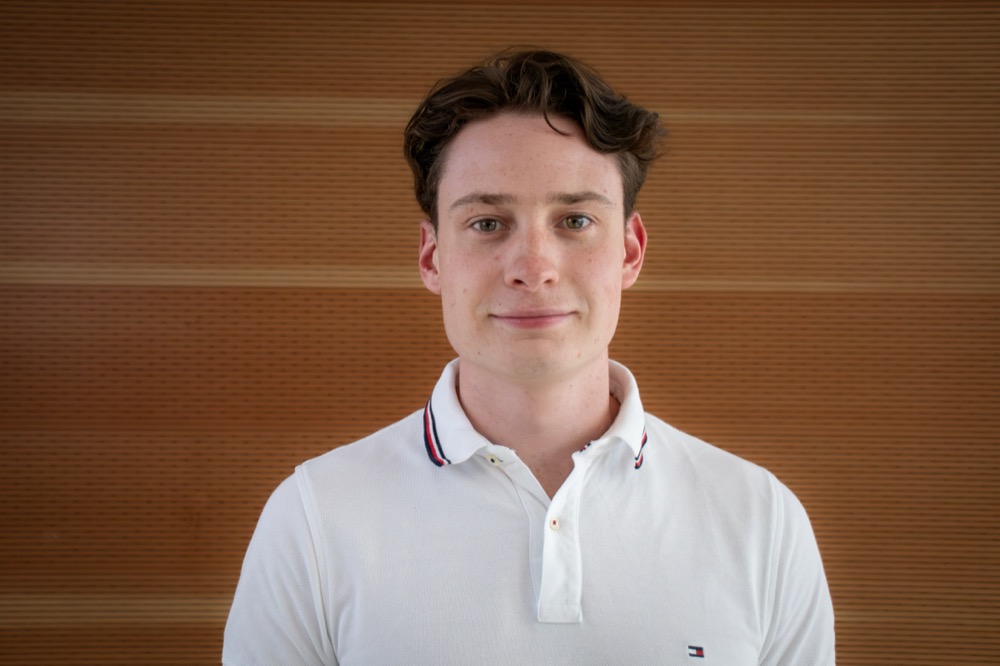
Adam Kuca
Technical founder and AI research engineer. Working on agents that build software, self-improving systems, and learning through experience.
Right now, I'm working on agent harnesses for cloud infrastructure at Michigan. The question is how much more a small open model can do with better tools and feedback. I started by studying xAI's Grok Build, then built my own harness. On 50 held-out Terraform tasks, it helped Qwen 27B reach Max-level results on policy checks and judged quality. I'm now testing it on larger, multi-file projects.
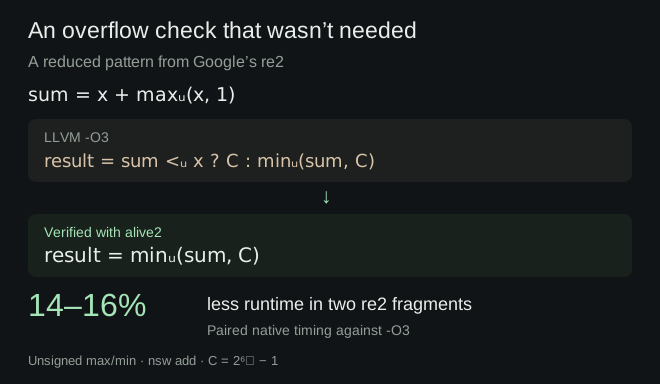
I'm also doing research with Professor Gabriel Poesia on using verified self-play to optimize code. Models propose optimizations, but an improvement only counts if alive2 proves it correct and it runs faster on real hardware. So far, I've found two fragments from Google's re2 that ran 14–16% faster than LLVM's -O3. I'm extending this work to PyTorch code optimization, and working with Professor Ang Chen on emulators for cloud-infrastructure agents.
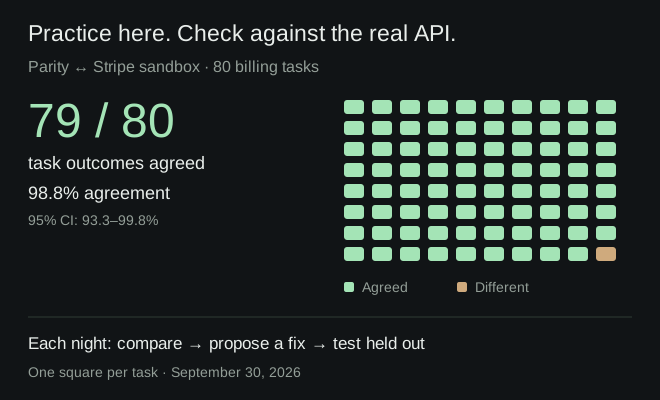
Recently, I built Parity, a Stripe Billing simulator that lets agents work with subscriptions, invoices, payments, and webhooks without using the real API. Each night, it compares its behavior against the real Stripe sandbox and tries to fix the differences. I built the working system in one week using coding agents. I'm interested in how environments like this could let agents practice, learn, and be tested before they act in the real world.
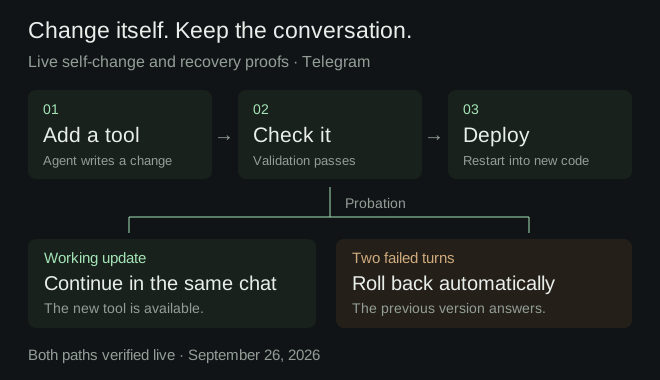
I've also been running a personal AI computer on my Mac. It talks to me through Telegram, handles incoming work, and can change its own tools and code. I designed the system and directed the build using coding agents. The part I wanted to see was whether it could make a change, restart, and carry on in the same conversation, or recover when an update broke it. Both worked in the live tests. It's still an experiment, and I'm learning quite a lot from using it every day.
One thing I keep thinking about is how software should really be discovered through use, not just written from scratch. Usually, software is built based on what the author thinks will work, and then everyone else has to figure out how to use it. I believe it's better to start with something general, like an agent that roughly does the right things, and then let the things that actually work turn into real tools and code as you go. A lot of my research and work on Transmute comes back to this question: how can systems learn from what they do, and keep getting more capable?
Previously, I co-founded Insora and spent a year leading engineering there. We built a secure AI workspace for European small and medium businesses, helping them break down decisions into testable ideas and real evidence. I had 50+ discovery conversations across about 25 SMEs to understand what they needed, built the system, and delivered a client pilot in six days. This past summer, I worked at MAMA AI in Prague, where I focused on building and improving their evaluation system for production LLM pipelines. I managed to increase extraction accuracy on multimodal (text, PDF, scanned-image) documents from 77% to 87%, which was really rewarding.
I'm currently finishing my M.S. in Computer Science & Engineering at Michigan (4.0 GPA, expected graduation in December 2026). Before this, I earned a first-class CS degree from St Andrews a year early and published a first-author paper at the LLMSolve workshop at CP 2025. I'm based in Ann Arbor.
Selected work
All projects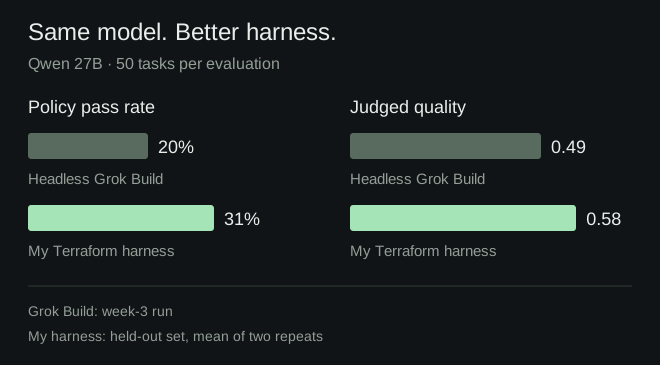
Agent harnesses for cloud infrastructure
How much more can a small open model do with a better harness? I built a Terraform agent with searchable offline docs, feedback after edits, and a final requirements check. Qwen 27B reached 31% policy passes and a judged score of 0.58 on 50 held-out tasks, compared with 20% and 0.49 in the earlier headless Grok Build run.
Verified self-play for code optimization
Models propose optimizations to real LLVM code, but a result only counts if alive2 proves it correct and it runs faster on real hardware. I found two fragments from Google's re2 that ran 14–16% faster than -O3. The harness works over 69 MB of IR from ten production codebases.
Parity
A stateful Stripe Billing simulator for testing agents without the real API. It compares itself with the Stripe sandbox each night and proposes fixes for the differences. An LLM agent's outcomes agreed with the sandbox on 79 of 80 billing tasks.
A personal AI computer
I wanted an assistant that could keep working and change the parts of itself that weren't useful. I designed it and directed the build using coding agents. In live tests, it added a tool, restarted into the new version in the same chat, and recovered automatically from a broken update.
$ transmute compile --benchmark tau2-retail --receipt
[compile]      120 traces → delta-only specialist
[holdout]      180 sealed tasks × 4 trials
[pass^1]       93.9% compiled / 94.3% frontier
[pass^4]       86.1% compiled / 81.1% frontier
[cost]         ~18× lower | frontier calls −99.1%
[constructor]  240 held-out tasks, four trials each
[cheap model]  88.5% → 92.4% | pass^4 66.3% → 74.6%
[paired]       96 wins / 59 losses | p = 0.0037
[human rules]  0
[guard]        frontier fallback for unfamiliar cases
[claim]        parity on single attempts; repeatability is higher
Transmute
Takes the traces and outcomes from a production agent and turns them into specialized tools, code and small models, with the frontier model kept as a verified backup for edge cases. The hand-compiled prototype reached parity with GPT-5.2 on 180 sealed retail tasks at about 18 times lower cost, with 99% fewer frontier calls.
Insora
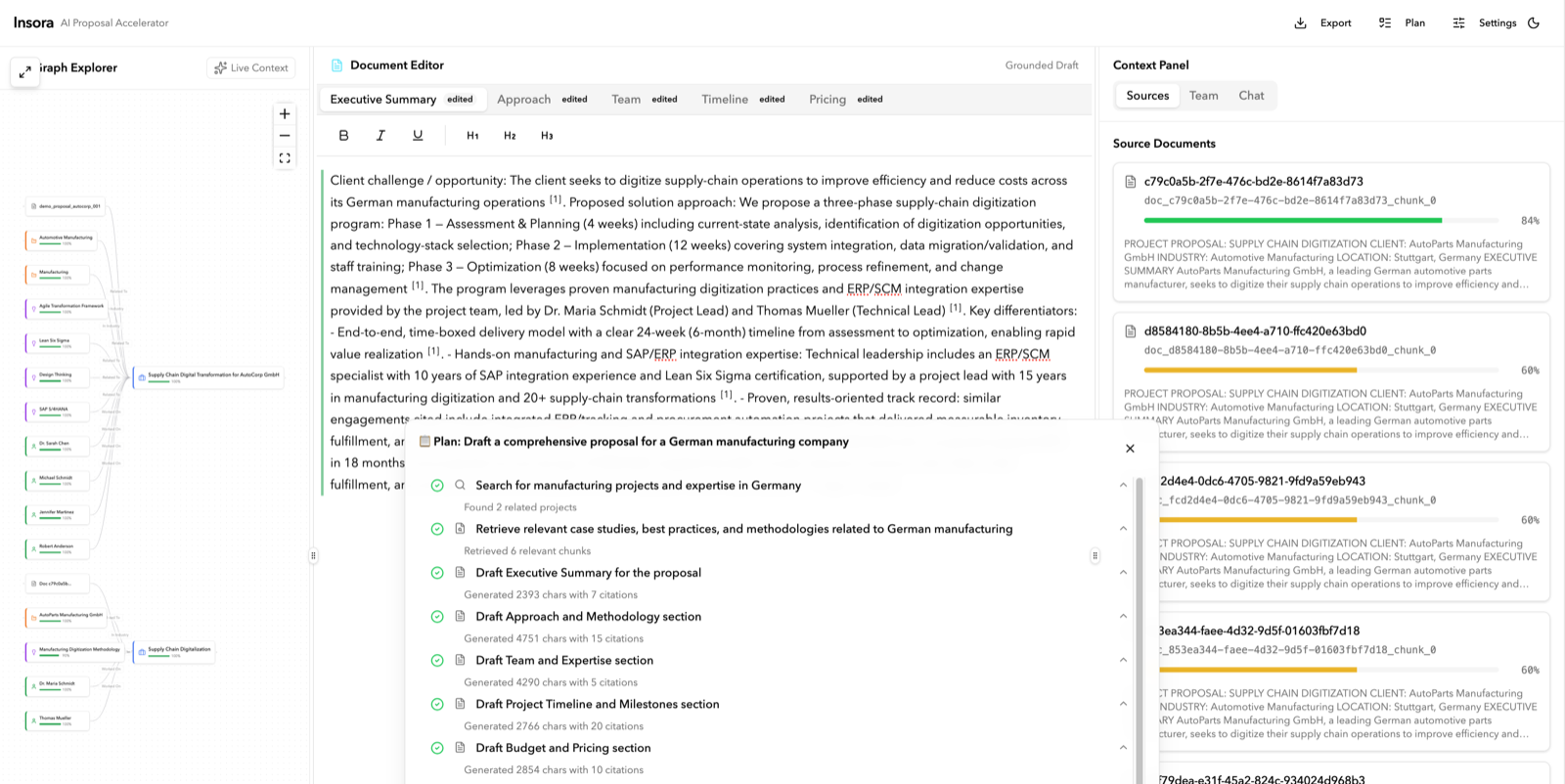
A secure AI workspace for European small and medium businesses that breaks a decision down into testable hypotheses and real evidence. I had 50+ discovery conversations across about 25 SMEs and built the system. Our pilot shipped in six days and answered 25 expert questions across 150+ research papers with zero hallucinations or contradictions.
Research, open source and weekend builds are in the project index.
Experience
Education
What I'm looking for
I'm open to two paths. The first is building Transmute, where I'm looking for design partners who already run agents in production and, in time, a co-founder who knows a market as well as I know the technology. The second is joining an early team as a founding engineer or research engineer, ideally working on agents, post-training, or evaluation infrastructure. What I enjoy most is owning an ambiguous problem end to end: defining the benchmark, building the system, figuring out why it fails, and shipping it.
I've done the cold outreach, the discovery calls, and the pilot delivery, not just the code, and I really like that side of the work too. I'm available part-time right now and full-time from January 2027, ideally in San Francisco and in person. I'm on F-1 OPT, which covers roughly three years before I'd need sponsorship.
Recognition
YC AI Startup School — selected participant, San Francisco, July 2026.
Entrepreneurs First — finalist at the London selection days, 2025. A few intense weeks of ideation, co-founder matching and pitching.
Radical Ventures AI Founders Masterclass — selected for their program for technical AI founders, 2025.
Entrepreneurial Leadership Program — fellow in the 2026 cohort at U-M's Center for Entrepreneurship.
LLMSolve workshop, CP 2025 — first-author paper, presented in Glasgow.
CAMEL-AI — merged a contribution into the 17k-star multi-agent framework.
Dean's List, St Andrews — every year from 2022 to 2025, graduating with First Class Honours a year early.
FastStart Digital Launchpad — won funding for StudyBuddy, a peer-mentoring app I founded as an undergrad.
European Junior Champion, Zatre — at eleven. It's a board game where you place numbered tiles to make sums of 10, 11 or 12, and I still think it explains a lot about me.
If you're building something where agents have to work reliably in production, or you're looking for a technical co-founder, please say hello. I reply to everything.
Ann Arbor, MI · (734) 773-7019 · CV (PDF)